
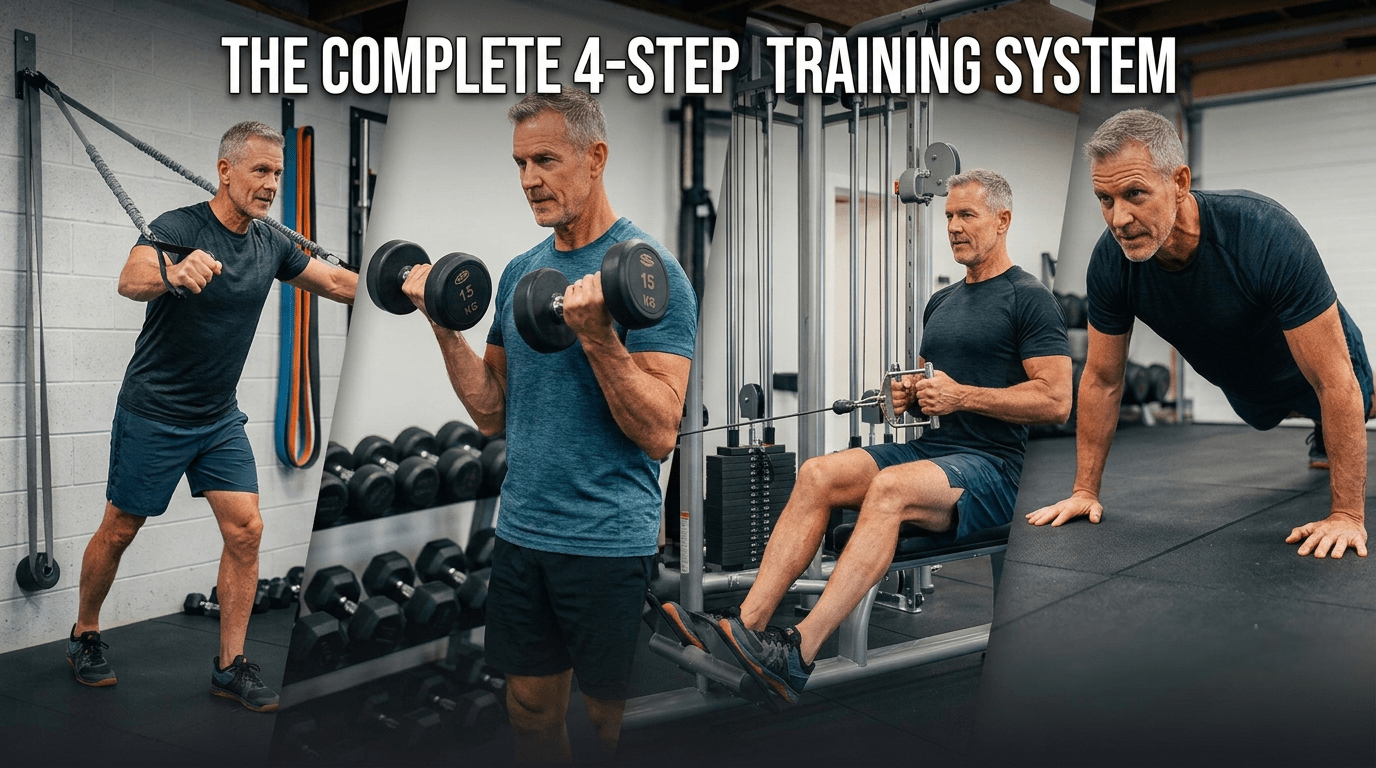
Most men looking to master strength training over 50 make the exact same mistake. They pick one tool, build a dogmatic religion around it, and ignore everything else.
Some think heavy dumbbells are the only way to build real muscle. Others think bodyweight training is all you need. Some won’t leave the safety of the gym machines, while others swear strictly by resistance bands.
The truth? They’re all wrong.
Every single piece of equipment is just a tool. None of them are magic on their own. If you want smart strength training over 50 that builds raw power while protecting your joints, you need to stop arguing over tools and start running a system.
Here is the straightforward breakdown of the pros, the cons, and how to combine them for actual results.
How to Combine Tools for Strength Training Over 50
1. Resistance Bands for Strength Training Over 50
The Good:
-
Joint-Friendly: Bands exert less force at the bottom of a movement where your joints are most vulnerable, and peak at full contraction.
-
Portable: Zero excuses when traveling or working out at home.
-
Core Stability: Great for rotational movements and core integration.
The Bad:
-
Hard to Track Progression: It’s much harder to measure exact strength gains compared to loading an extra plate on a bar.
-
Inconsistent Resistance: The tension can spike too sharply at the top of a rep, cutting short your range of motion.
2. Dumbbells for Strength Training Over 50
The Good:
-
Fixes Muscle Imbalances: Dumbbells force both sides of your body to pull their own weight. No hiding weak limbs.
-
Natural Movement: Unlike fixed machines, dumbbells let your wrists, elbows, and shoulders move in a natural arc.
-
Clear Progressive Overload: Going from 15 kg to 17.5 kg gives you a clear, undeniable metric of progress.
The Bad:
-
Higher Risk of Injury: Poor grip or failing a heavy rep without control can easily tweak a shoulder or lower back.
-
Uneven Resistance: Gravity means tension drops off completely at certain points of a movement (like the top of a lateral raise).
3. Resistance Machines
The Good:
-
Safe Isolation: Fixed paths let you push a muscle to complete exhaustion without worrying about losing balance or dropping weights.
-
Constant Cable Tension: Cables keep smooth, uninterrupted tension on the muscle through the full range of motion.
-
Bypasses Injuries: Perfect when you need to train around a bad knee or lower back tweak.
The Bad:
-
Fixed Trajectory: A fixed machine path doesn’t care about your specific joint structure and can irritate joints over time.
-
Lazy Stabilizers: The machine does the balancing work for you, meaning your core and stabilizer muscles go on holiday.
4. Bodyweight Training (Calisthenics)
The Good:
-
Real-World Capability: Press-ups, pull-ups, squats, and lunges teach you how to control your own body mass—essential for fall prevention and real-life function.
-
Zero Cost: No gym membership required.
-
Core Integration: Forces your entire kinetic chain and core to fire continuously.
The Bad:
-
Hard to Scale: If you can’t do a proper pull-up yet, regressing the exercise takes actual skill and technique.
-
Lower Body Limits: You cannot build serious leg strength or bone density long-term with just air squats.
How to Combine Them for Peak Results
Stop looking for the “best” exercise tool. The secret isn’t picking one—it’s using them in the right order during your workout.
Here is how you run the system in a single session:
-
Warm-Up (Bands): Use light bands for face-pulls and mobility to flood the joints with fluid and fire up the nervous system.
-
Main Lifts (Dumbbells or Bodyweight): Tackle your heavy compound moves (like dumbbell goblet squats or incline press-ups) while you are fresh and full of energy.
-
Hypertrophy (Machines): Move to machines mid-workout (like cable rows or leg presses) to safely fatigue the target muscles without frying your lower back or joints.
-
Finisher (Bands): Cap off the session with high-rep band work to drive blood into the muscle, create a pump, and finish safely.
The Bottom Line
Use bodyweight to master movement, dumbbells to build raw structural strength, machines to safely isolate muscles, and bands to keep your joints healthy.
Stop guessing, start training with a purpose, and treat your workout like a mandatory system.
Ready to stop wasting time in the gym?
At 50+ Fitness for Men, we build structured, joint-friendly programs designed specifically for men over 50 who want clear results without ruining their joints. Visit 50+ Fitness for Men or join our community in the Facebook Group to get started.